
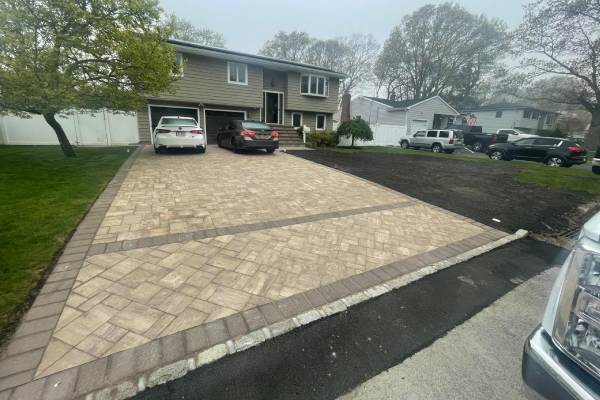
If you’re pricing a new driveway, the first question is usually: how much does block paving cost in the UK in 2026? The honest answer is: it depends on the groundwork, drainage, access, and the blocks you choose.
This guide breaks down the average block paving driveway cost UK homeowners pay in 2026, what should be included in a proper quote, and the common add-ons that change the price. I’ll also point you to useful internal resources (block paving, installation, drainage) so you can compare quotes properly.
If you’re local, South East Block Paving Ltd covers block paving and related groundworks & drainage across Waltham Abbey and nearby areas.
The quick answer: average block paving cost UK in 2026
Most cost guides put block paving installation in roughly this range:
- £90 to £130 per m² for a block paved driveway in 2026 (a common “all-in” range).
- Another widely used UK benchmark range is £70 to £120 per m², with many projects landing £85 to £110 per m².
A popular “rule of thumb” you’ll see quoted is ~£100 per m², and around £5,500 for a 50m² driveway (typical double).
“The average block paving cost per m² is £100.”
Important: those numbers usually assume a standard domestic job with normal access and typical groundwork. If your existing drive needs heavy excavation, extra drainage, or you choose premium blocks, the cost moves.
What you’re actually paying for (the real cost breakdown)
A proper block paving quote is not “blocks + labour”. It’s a full mini-build. The main cost buckets are:
1) Excavation and waste removal
This covers breaking out old surfaces, digging to the right depth, and disposing of spoil.
As a technical reference, Pavingexpert explains that for a typical domestic driveway, excavation is usually 200–250mm below finished paving level (based on typical build-up layers).
“The excavation depth for a typical domestic driveway is 200–250mm below finished paving level.”
Why this matters to your price: digging deeper, removing more spoil, and dealing with awkward access can add a lot.
2) Sub-base (the foundation)
This is the compacted layer that stops sinking and tyre ruts. If installers cut corners here, you pay later.
Good guidance recommends building sub-base in layers and compacting properly. For example, Pavingexpert advises laying sub-base in layers not exceeding 150mm and compacting each layer.
Marshalls also describes using an MOT Type 1 sub-base and compacting in layers (their example uses 75mm layers).
3) Edging restraints
Edges stop the blocks spreading and keep everything “locked” in place. Kerbs/edging set properly is a quality marker.
4) Bedding layer, laying, cutting, jointing
This is the skilled finish work: correct levels, neat cuts, proper jointing sand, and compaction.
5) Drainage (sometimes optional, often essential)
If your drive puddles, slopes toward the house, or you’re dealing with a large front area, drainage design can be a major cost factor.
For local homeowners, it’s worth reading your contractor’s drainage approach and (if needed) linking to a Groundworks & Drainage service page for clarity.
Costs by driveway size (realistic examples)
These examples use the common 2026 guide ranges above, so you can sanity-check quotes:
Small single driveway: ~30m²
- Rough guide: £2,700 to £3,900 (at £90–£130/m²).
Typical double driveway: ~50m²
- Rough guide: ~£5,500 average often quoted in UK guides.
Larger driveway: ~80m²
- Rough guide: £7,200 to £10,400 (at £90–£130/m²).
These are not “quotes”, but they help you spot when something is unrealistically cheap for the scope.
Block choice: concrete vs clay vs natural stone (why prices vary)
Material is a big driver of cost.
- Concrete block paving is usually the most budget-friendly (lots of colours and finishes available).
- Clay and natural stone blocks typically cost more (and may involve more careful detailing).
If someone quotes you a premium-looking driveway at a bargain price, ask exactly what block type is included and whether it’s a standard concrete block or something higher-end.
The “extras” that change the price (and why they’re often worth it)
Here are the common add-ons that push the average block paving driveway cost UK homeowners pay upward:
Drainage channels, soakaways, or permeable solutions
In England, planning guidance is clear: you generally won’t need planning permission if the surface is permeable or water drains to a permeable area. But if you’re laying a traditional impermeable driveway over 5m² without directing water to a permeable area, planning permission may be needed.
“You will not need planning permission… if… permeable… such as gravel [or] permeable concrete block paving…”
If your contractor recommends drainage work, it’s usually to protect your home and keep you compliant, not to inflate the bill.
Edging kerbs and soldier courses
These upgrades improve strength and finish. Drives without solid edging can spread and dip at the sides.
Steps, thresholds, and levels near the house
Getting levels right near your home matters for damp prevention. Brett Landscaping notes (referencing BS 7533) that finished pavement levels should be at least 150mm below the damp-proof course (DPC).
This can influence excavation depth and how the driveway meets paths and entrances.
Complicated shapes and lots of cutting
Curves, manholes, angled boundaries and fancy patterns take time and skill. Time is money.
Removal of old concrete, deep dig-outs, or poor ground
If you have an old concrete base, thick tarmac, tree roots, or soft ground, your costs can rise due to extra work and materials.
How to read a quote like a pro (so you can compare properly)
When you ask “how much does block paving cost in the UK?”, the better question is:
What exactly is included for that price?
A good quote should clearly state:
- Excavation depth (and disposal included).
- Sub-base type and thickness, and compaction approach.
- Edging restraints (what type, where used).
- Drainage plan (falls, channels, soakaway/permeable).
- Block type, colour, thickness, and laying pattern.
- Finish details: jointing sand, compaction, clean-up.
If you want a plain-English walkthrough of the build process, link internally to a Block Paving Installation Guide so homeowners can see what “good” looks like.
And for service-level detail, link to your Block Paving Contractors page.
How to keep costs sensible (without cutting corners)
Here are the safest ways to reduce your block paving cost UK wide, while still getting a driveway that lasts:
- Keep the shape simple: fewer curves = less cutting.
- Choose a standard block: premium blocks can look amazing, but they do add cost.
- Prioritise groundwork over “extras”: don’t downgrade the sub-base to afford a fancier border.
- Fix drainage early: it’s cheaper than fixing puddling and re-laying later.
If you’re dealing with sunken areas or movement on an existing driveway, it may be worth linking internally to Block Paving Repairs or Driveway Repairs to compare repair vs replacement.
Should you seal block paving (and does it change the cost)?
Sealing is optional. Some homeowners like the enhanced colour and stain resistance, but timing matters.
Pavingexpert advises that sealants should not be applied to paving less than 3 months old, and not before efflorescence has weathered out.
So if a quote includes sealing immediately after laying, ask questions.
The takeaway: what you should budget for in 2026
For most UK homes, a realistic budget for block paving installation in 2026 often sits around:
- £90–£130 per m², with many projects around £85–£110 per m² depending on complexity.
- A typical 50m² double driveway is often quoted around £5,500 in average-cost guides.
Your final price will mainly depend on groundwork, drainage, access, and block choice.